


Saunas
How to Use a Sauna and Cold Plunge at Home
The short answer
The best sauna and cold plunge routine starts with 10 to 15 minutes of heat. Then take a cold dip of 30 seconds to 2 minutes and rest for a few minutes. Repeat it 2 or 3 times, 2 or 3 days a week. Alternating hot and cold eased muscle soreness better than rest in a review of 18 trials.[1] At home, you need space for both pieces and two circuits. The sauna runs on 240V and the plunge on 120V.

In this article
At a glance
Sauna and cold plunge at a glance
Here's the routine we recommend if you're starting out.
- Order
- Sauna first, then the cold plunge
- Sauna
- 10 to 15 minutes per round
- Cold dip
- 30 seconds to 2 minutes
- Water
- 45 to 59°F, the range used in studies
- Rounds
- 2 or 3, with rest in between
- How often
- 2 or 3 days a week to start
- At home
- A 240V circuit for the sauna and a 120V circuit for the plunge
The order
Sauna or cold plunge first?
Start with the sauna. Heat first means you step into the cold water already warm. The cold dip feels easier to handle. That contrast is the point of the routine.
Most routines end on cold. Many people like the alert feeling it leaves. If you use your sauna in the evening to wind down, end with a last round of heat or a warm shower instead.
Tip: keep the two pieces a few steps apart. A short, clear path between them makes each switch quick.
Step by step
A sauna and cold plunge routine, step by step
This is a common starting point. Begin with shorter rounds than you think you need, and build up over a few weeks.
- Heat the sauna. Revive saunas reach up to 194°F, and you can start them from the app. If you're new to heat, start at a lower setting and raise it over time.
- Sit in the heat for 10 to 15 minutes. Sit on the lower bench at first. The air is cooler there.
- Rinse off. A quick shower removes sweat before you get in the plunge. It also keeps the plunge water cleaner.
- Take a short cold dip. Studies used water between 45 and 59°F.[3] Stay in for 30 seconds to a minute at first and build up to 2 minutes.
- Rest for about 5 minutes. Wrap up in a towel and let your breathing settle.
- Repeat 2 or 3 times. Drink water before and after your session.
One round takes about 20 minutes. Do 2 or 3 rounds.
Frequency
How often to sauna and cold plunge
We recommend 2 or 3 sessions a week to start. Add days once the routine feels easy. In a large Finnish study of 2,315 men, people used the sauna anywhere from once a week to 7 times a week.[2]
Cold water studies also use many schedules, from a single dip to daily sessions.[3] What matters most is a routine you keep. Having both pieces at home makes that easier. You skip the drive to a spa and the booking.
If you lift weights
If building muscle is your main goal, avoid a cold plunge right after every strength session. Regular cold immersion straight after resistance training may reduce muscle growth.[5] We recommend plunging on rest days or a few hours away from lifting.
Home setup
What you need for a sauna and cold plunge at home
A home setup comes down to four things. We compared the published specs of every Revive combo we sell to give you the numbers below.
Space
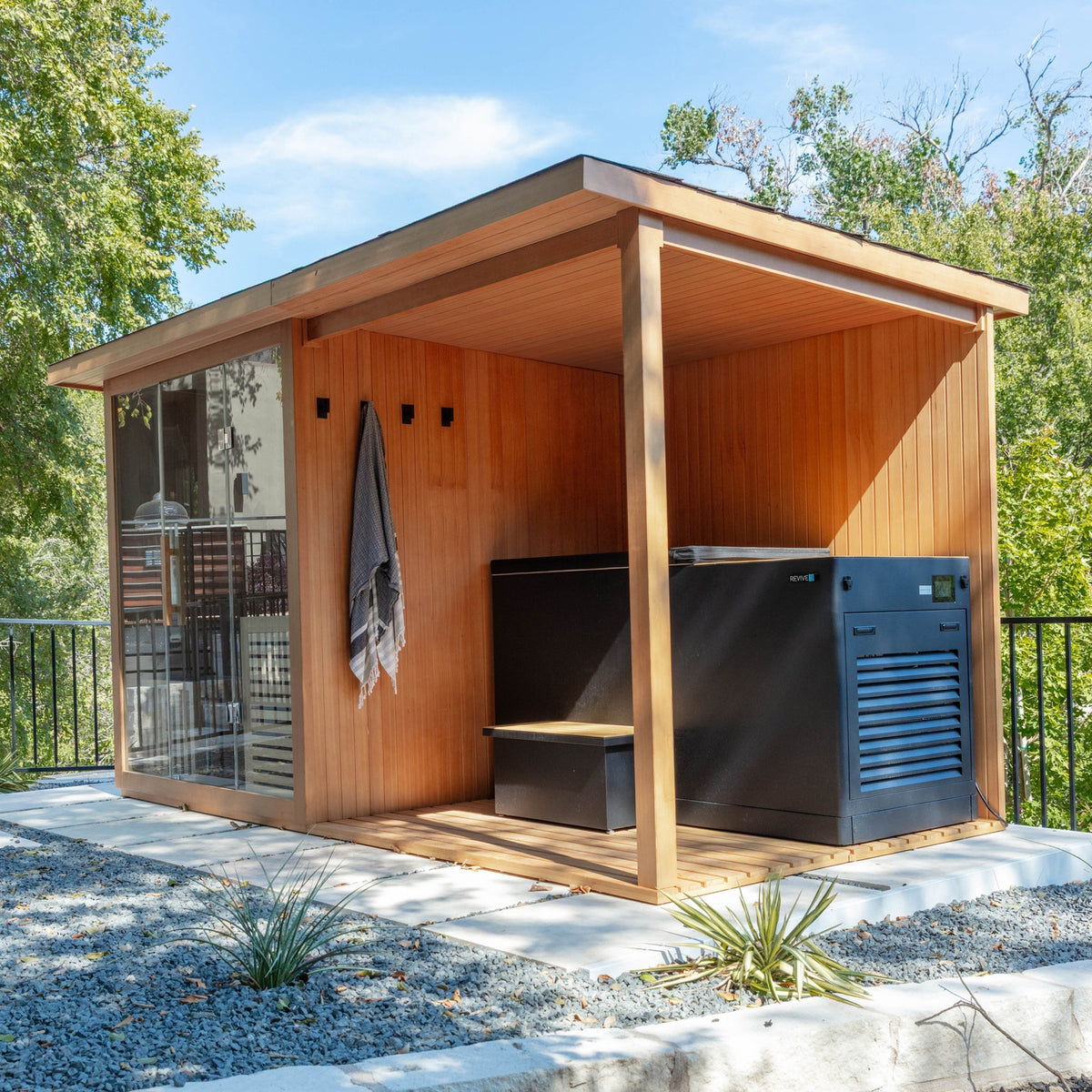
The Revive 2 person sauna base is about 40 by 47 inches. The 4 person base is about 67 by 70 inches. Add the plunge footprint and a clear path between both pieces. The covered deck version is about 67 by 145 inches and holds the plunge under the roof.

Power
You need two circuits. The 2 person sauna uses a dedicated 240V, 20A circuit. The 4 person sauna uses a dedicated 240V, 50A circuit. The plunge runs on 120V, on a GFCI outlet or its own 15A circuit, depending on the model.
Water
No plumbing is needed. You fill the plunge with a garden hose, and its filter keeps the water clean. To change the water, you drain it through a hose adapter. Leave 24 inches of open space around the chiller fan.
Weather
Both Revive saunas work indoors or outdoors, with a roofing kit included. In cold climates, protect the plunge and its chiller from freezing. Freeze damage isn't covered by the warranty.

What to check before you buy
- Space: both footprints, the path between them, and room around the chiller.
- Electrical panel: room for a 240V sauna circuit and a 120V plunge circuit. Ask an electrician to check it.
- Surface: level and stable. A filled plunge can weigh more than 1,000 pounds.
- Delivery path: gates, turns, and stairs from the street to the final spot.
- Winter: a plan to protect the plunge if you get freezing weather.
Not sure which setup fits your space? Call us at (302) 208-4650. We compare the specs for you and help you choose before you buy.
Our combos
Sauna and cold plunge combos compared
A combo puts the sauna and the plunge in one order, with free shipping. All four combos below use the same 4 person sauna. The difference is the plunge.

| Combo | Plunge | Water temperature | Heats the water | Price |
|---|---|---|---|---|
| 4 person sauna + Inflatable Pod | Upright pod | Down to 37°F | No | See current price |
| 4 person sauna + Inflatable Plunge | Full length, lie back | 35 to 107°F | Yes | See current price |
| 4 person sauna + Acrylic Plunge | Fixed acrylic tub | 32 to 107°F | Yes | See current price |
| 4 person sauna + Luxury Plunge | Stainless steel, all in one | Down to 23°F | No | See current price |
We recommend the 4 person sauna with the Inflatable Plunge for most homes. The sauna has room for guests, and the plunge cools and heats the water. You can use it all year.
Before you start
Stay safe with heat and cold
Heat and cold both put stress on your heart and blood pressure. Follow these steps every session.
- Talk to your doctor first if you have a heart condition or high blood pressure, are pregnant, or take medication that affects your heart.
- Skip alcohol before and during a session.
- Enter the cold slowly. Cold water can make you gasp. Keep your head above water and breathe calmly, without holding your breath.[6]
- Have someone nearby, and get out if you feel dizzy or unwell.
The research
Benefits of sauna and cold plunge
A regular sauna and cold plunge routine supports how you recover and how you feel. These are the studies behind it.
Less soreness after hard training
Alternating warm and cold water eased muscle soreness after exercise. In a review of 18 trials, it reduced soreness and strength loss better than passive rest, from the first hours up to 4 days later.[1]
Feeling recovered sooner
A review of 52 studies looked at cold water immersion after strenuous exercise. A day after high intensity exercise, people who used cold water had less muscle soreness and felt more recovered than people who rested.[4]
Lower stress and better sleep
A 2025 review of 11 trials with 3,177 adults found lower stress 12 hours after a cold dip. People who kept using cold water also reported better sleep quality and quality of life.[3]
Our verdict
Is a sauna and cold plunge at home worth it?
We think yes. It pays off when you use it a few times a week. The routine is simple, and the research on recovery and wellbeing is solid. At home, it fits your schedule. That's what makes the habit stick.
Start with the space and the two circuits. Then choose the plunge that matches the water you want.
FAQs
Frequently asked questions
Start with the sauna. Being warm first makes the cold dip easier to handle. Most routines end on cold, but you can end with heat in the evening.
Yes. Alternating heat and cold eased muscle soreness better than rest in a review of 18 trials. Cold water was also linked to lower stress and better sleep in a 2025 review.
Start with 30 seconds to a minute. Build up to 2 minutes over a few weeks.
About 10 to 15 minutes. Start shorter if you're new to heat.
We recommend 2 or 3 sessions a week to start, with 2 or 3 rounds each time. Add days as it becomes a habit.
You can. We recommend starting with a few days a week and adding more once your routine feels easy.
Not in a meaningful way. Most of the weight you lose in a sauna is water. It comes back when you drink. Our dietitian reviewed guide explains why. Read the guide.
Yes. Revive traditional saunas work indoors or outdoors. Place the plunge on a level, stable surface with 24 inches of space around the chiller fan, and protect it from freezing. See our sauna and cold plunge combos.
Sources
Sources and methodology
Reviewed November 13, 2026. We compared the published specs of the 15 Revive sauna and cold plunge combos we sell and read the studies below. The studies look at sauna bathing, cold water immersion, and contrast water therapy, not the products shown here.
- Bieuzen F, Bleakley CM, Costello JT. Contrast water therapy and exercise induced muscle damage: a systematic review and meta-analysis. PLoS One. 2013;8(4):e62356. DOI
- Laukkanen T, Khan H, Zaccardi F, Laukkanen JA. Association between sauna bathing and fatal cardiovascular and all-cause mortality events. JAMA Intern Med. 2015;175(4):542-548. DOI
- Cain T, Brinsley J, Bennett H, Nelson M, Maher C, Singh B. Effects of cold-water immersion on health and wellbeing: a systematic review and meta-analysis. PLoS One. 2025;20(1):e0317615. DOI
- Moore E, Fuller JT, Buckley JD, et al. Impact of cold-water immersion compared with passive recovery following a single bout of strenuous exercise on athletic performance in physically active participants: a systematic review with meta-analysis and meta-regression. Sports Med. 2022;52(7):1667-1688. DOI
- Piñero A, Burke R, Augustin F, et al. Throwing cold water on muscle growth: a systematic review with meta-analysis of the effects of postexercise cold water immersion on resistance training-induced hypertrophy. Eur J Sport Sci. 2024;24(2):177-189. DOI
- Royal Life Saving Society UK. Shallow water blackout, hyperventilation, and breath holding (GS005). rlss.org.uk
This article is for general information and isn't medical advice. How Kinaura uses FDA terms.
