




Recovery
Contrast Therapy: What It Is, Benefits, and How to Do It
The short answer
Contrast therapy is switching between heat and cold in short, timed rounds. In a meta-analysis of 18 trials, it eased muscle soreness for up to 96 hours after hard exercise, compared with rest.[1] Studies use about 1 minute in hot water (38 to 40°C) and 1 minute in cold (about 10 to 15°C), for up to 15 minutes.[2] At home, a sauna and a cold plunge follow the same idea with longer heat. We recommend it after hard training, 2 or 3 times a week.

In this article
Summary
At a glance
- What it is
- Heat and cold in alternating rounds
- Main benefit
- Less soreness after hard training
- Protocol in studies
- About 1 min hot and 1 min cold, equal time, up to 15 min
- Water temperatures
- Hot 100 to 104°F · Cold 50 to 59°F
- With a sauna
- 10 to 15 min of heat, 30 s to 2 min of cold, 2 or 3 rounds
- How often
- 2 or 3 sessions a week
- Best timing
- After endurance or team sport sessions. Away from lifting sessions
The basics
What is contrast therapy?
Contrast therapy means moving between heat and cold several times in one session. The heat mode can be a hot tub, a sauna, or a hot shower. The cold mode can be a cold plunge, an ice bath, or a cold shower.
Researchers call the water version contrast water therapy. Elite athletes use it to recover between training sessions and competitions.[2] In the Nordic countries, the same habit takes the form of a sauna followed by a dip in cold water.[8]
How it works
How contrast therapy works
Contrast therapy works by changing how much blood flows to your skin and muscles. Each switch reverses that flow.[7]
Heat opens your blood vessels
Heat widens the blood vessels near your skin. More blood reaches your muscles. Your heart beats faster to move it. This increases filtration pressure and oxygen delivery.
Cold narrows them and wakes you up
Cold does the opposite. Cold first narrows your blood vessels. Then there is a rebound effect. Your blood flow increases. Your nervous system reacts within seconds. You come out of the cold fully awake.
Switching creates a pumping effect
Going back and forth makes your vessels open and close again and again. Researchers describe it as a pumping effect that moves blood through tired muscles and repeating this cycle is thought to move blood and clear waste better than heat or cold alone.[7]
Blood flow, explained
What heat and cold do to your blood vessels
Vessels near your skin widen. More blood and oxygen reach your muscles.
Vessels narrow first. Then blood flow rebounds and increases.
Going back and forth pumps blood through tired muscles.
The research
Contrast therapy benefits: what the research shows
The research on contrast therapy looks at recovery after hard exercise. Three large reviews give the clearest picture.
Less soreness after hard training
A meta-analysis of 18 trials compared contrast therapy with rest. People who used it had less muscle soreness at every check, from the first hours up to 96 hours after exercise.[1]
A second review of 59 studies and 1,367 people compared ten recovery methods. In the first 24 hours, contrast therapy ranked second for easing soreness. Only a hot pack ranked higher.[4]
In a 2025 review, 67% of included studies demonstrated reduced swelling, while 40% showed decreases in soreness or muscle pain following a four-day protocol of alternating one-minute cold and hot intervals for 14 minutes per session.[10]
Lower muscle damage markers
Creatine kinase (CK) is a blood marker of muscle damage. It rises after hard exercise. A network meta-analysis of 57 studies and 1,220 people compared four water and cold methods. Contrast water therapy ranked first for bringing CK down.[3]
The research
What three large reviews found
96h
Less muscle soreness than rest, from the first hours up to 96 hours after hard exercise
18 trials [1]
#1of 4
Water and cold methods for bringing down CK, a blood marker of muscle damage
57 studies, 1,220 people [3]
#2of 10
Recovery methods for easing soreness in the first 24 hours. Only a hot pack ranked higher
59 studies, 1,367 people [4]
Compared
Contrast therapy vs an ice bath
An ice bath keeps you in cold water the whole time. Contrast therapy adds heat between the cold rounds.
For soreness alone, the ice bath comes out ahead. A meta-analysis of 28 studies found cold water immersion more effective than contrast therapy for most recovery measures.[5] Contrast therapy still beats rest.[1]
We recommend the cold plunge on its own if less soreness is your only goal. If you also want the heat and the calm that comes with it, contrast therapy gives you both in one session.
Side by side
Contrast therapy vs an ice bath
Our pick: the cold plunge alone if less soreness is your only goal. Contrast therapy if you also want the heat.
Step by step
How to do contrast therapy
The protocol used in studies
A review of the research found the best results with equal time in hot and cold water, short rounds of about 1 minute, and up to about 15 minutes in total. Longer sessions didn't add more benefit.[2]
- Get into hot water at 100 to 104°F for about 1 minute.[9]
- Move to cold water at 50 to 59°F for about 1 minute.[2][9]
- Repeat, with the same time in hot and cold, for up to 15 minutes.
Another study demonstrated that a 30-minute contrast bath protocol (alternating four-minute hot and one-minute cold intervals) elevated oxygenated hemoglobin, total hemoglobin, and tissue oxygen saturation in the calf muscles of healthy adults.[11]
With a sauna
A sauna changes the timing. Air heats your body more slowly than water. You stay in longer. We suggest 10 to 15 minutes in the sauna, then 30 seconds to 2 minutes in the cold plunge, for 2 or 3 rounds. Our step by step sauna and cold plunge routine covers order, rest, and timing.
With a hot shower
A shower is the easiest place to start. Switch to hot for about 1 minute, then to cold for about 1 minute. Repeat 3 to 5 times. The studies used full body tubs. A shower reaches less of your body. We recommend it as a first step.
End on cold or warm
Most routines end on cold. You come out alert. Your body then warms itself up. In the evening, we suggest a last round of heat or a warm shower. It helps you wind down before bed.
Interactive tool
Session builder
Build your contrast therapy session
Your heat source
When you'll do it
One session
Hot tub protocol from the research [2]. Sauna and shower times are our recommendation. Talk to your doctor first if you have a heart or blood pressure condition.
Timing
When to do contrast therapy
After endurance and team sports
The studies above tested contrast therapy after exercise designed to make muscles sore.[1] We recommend it after the sessions that leave you sore the next day: long runs, hard rides, team sports, and interval work.
If you lift for strength or size
Cold right after lifting can slow your gains. In a 12 week study, 21 active men lifted twice a week. The group that sat in cold water for 10 minutes after each session gained less strength and muscle than the group that did active recovery.[6]
If building muscle is your goal, we recommend keeping the cold away from your lifting sessions. Use contrast therapy on rest days or after cardio.

How often
We recommend 2 or 3 sessions a week. It's a routine you can keep for years.
A study of experienced winter swimmers in Denmark gives a useful reference. They did 2 to 3 sessions a week, with about 11 minutes of cold and 57 minutes of sauna in total. Each dip lasted under 2 minutes.[8]
Before you start
Who should be careful with contrast therapy
Heat and cold both put extra work on your heart and blood vessels. Talk to your doctor before you start if you have a heart condition, high blood pressure, or poor circulation, if you react badly to cold, or if you're pregnant.[9]
- Skip alcohol before and during a session.
- Drink water before and after, especially after the sauna. Our guide on saunas and weight loss explains how much water you lose.
- Get out if you feel dizzy, sick, or numb.
This article is for general information and isn't medical advice.
At home
Bringing contrast therapy home
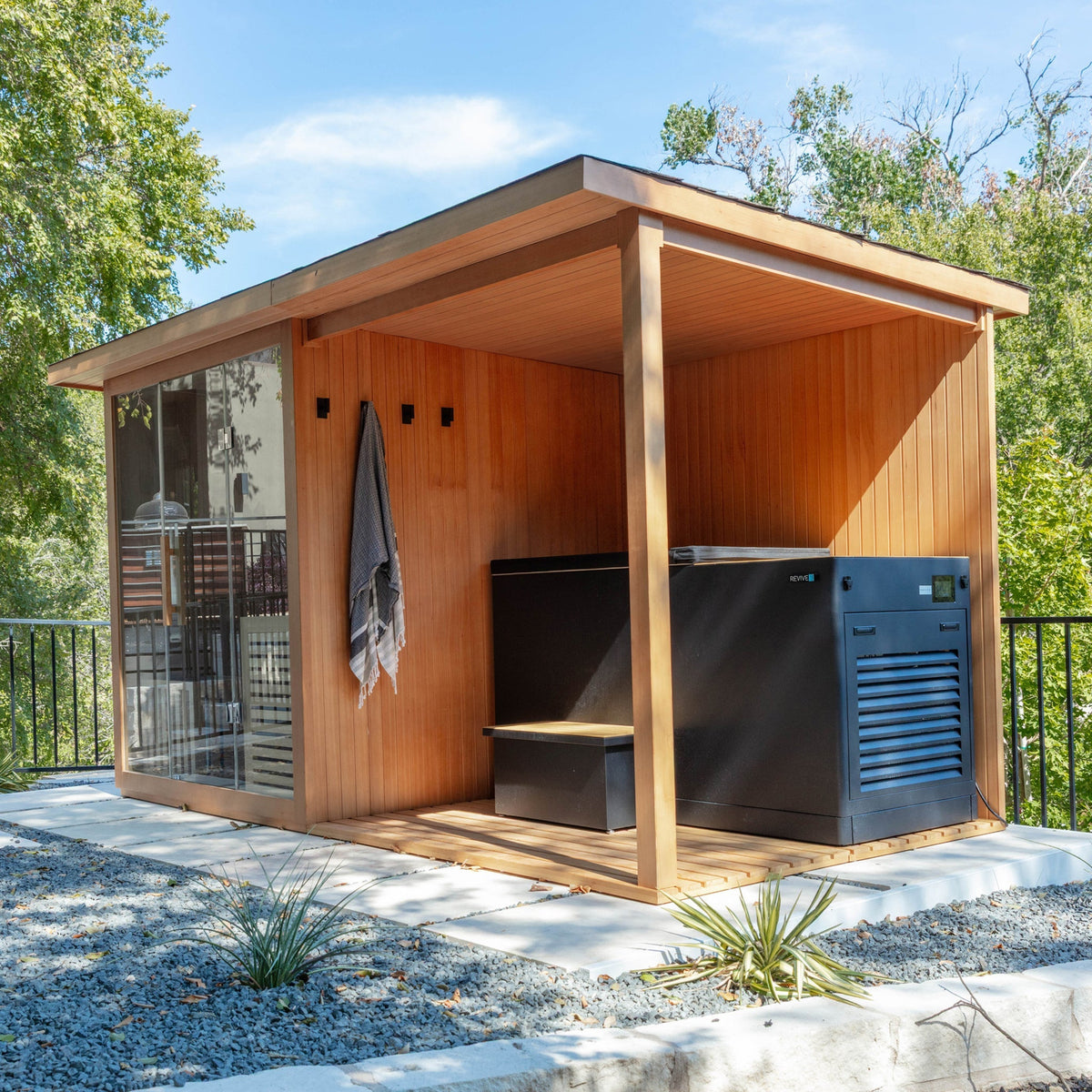
At home, contrast therapy needs a heat source and a cold one. The most complete setup pairs a sauna with a cold plunge. Our sauna and cold plunge combos bring both together. You can also build your own setup from our saunas and cold plunges.
Every home is different. If you have questions about space, power, or water, call us at (302) 208-4650. We'll help you choose.
Our verdict
Our verdict
Contrast therapy is one of the best studied ways to recover from hard training. It eases soreness better than rest. Keep the rounds short. End on cold in the morning and on warm at night. Keep the cold away from your lifting days. With a sauna and a cold plunge at home, it becomes a routine you'll look forward to a few times a week.
FAQs
Frequently asked questions
Yes, for recovery after hard exercise. In a meta-analysis of 18 trials, it reduced soreness for up to 96 hours compared with rest.[1]
Talk to your doctor first if you have a heart condition, high blood pressure, or poor circulation, if you react badly to cold, or if you're pregnant. Skip alcohol before and during a session.
After a hard endurance or team sport session, when you expect to be sore the next day. If you lift to build muscle, keep the cold away from your lifting days.
For soreness alone, an ice bath ranks higher in the research.[5] Contrast therapy ranks first for lowering CK, a marker of muscle damage.[3] It also adds heat to the session.
We recommend 2 or 3 sessions a week. Experienced winter swimmers in one study did about 11 minutes of cold and 57 minutes of sauna a week.[8]
Yes. Switch between about 1 minute of hot and 1 minute of cold, 3 to 5 times. A cold plunge covers more of your body. It's also closer to what the studies used.
For most healthy adults, yes. It eases soreness after hard training. Many people also use it to unwind. Check with your doctor first if you have a heart or blood pressure condition.
We recommend ending on cold in the morning and on warm in the evening. Cold leaves you alert. Warmth helps you wind down before bed.
Sources
Sources and methodology
Reviewed November 22, 2026. Clinical content reviewed by Dr. Amanda Lewin, PT, DPT. We read each study before citing it. This article summarizes research on contrast water therapy, cold water immersion, and sauna. The studies didn't test the products we sell.
- Bieuzen F, Bleakley CM, Costello JT. Contrast water therapy and exercise induced muscle damage: a systematic review and meta-analysis. PLoS One. 2013;8(4):e62356. DOI
- Versey NG, Halson SL, Dawson BT. Water immersion recovery for athletes: effect on exercise performance and practical recommendations. Sports Med. 2013;43(11):1101-1130. DOI
- Chen R, Ma X, Ma X, Cui C. The effects of hydrotherapy and cryotherapy on recovery from acute post-exercise induced muscle damage: a network meta-analysis. BMC Musculoskelet Disord. 2024;25(1):749. DOI
- Wang Y, Lu H, Li S, et al. Effect of cold and heat therapies on pain relief in patients with delayed onset muscle soreness: a network meta-analysis. J Rehabil Med. 2022;54:jrm00258. DOI
- Moore E, Fuller JT, Bellenger CR, et al. Effects of cold-water immersion compared with other recovery modalities on athletic performance following acute strenuous exercise in physically active participants: a systematic review, meta-analysis, and meta-regression. Sports Med. 2023;53(3):687-705. DOI
- Roberts LA, Raastad T, Markworth JF, et al. Post-exercise cold water immersion attenuates acute anabolic signalling and long-term adaptations in muscle to strength training. J Physiol. 2015;593(18):4285-4301. DOI
- Leonardi G, Portaro S, Milardi D, et al. Mechanisms and efficacy of contrast therapy for musculoskeletal painful disease: a scoping review. J Clin Med. 2025;14(5):1441. DOI
- Søberg S, Löfgren J, Philipsen FE, et al. Altered brown fat thermoregulation and enhanced cold-induced thermogenesis in young, healthy, winter-swimming men. Cell Rep Med. 2021;2(10):100408. DOI
- American Medical Association. 4 things to know about cold plunges and contrast therapy. 2026. ama-assn.org
- Rousse Y, Sautillet B, Costalat G, Brocherie F, Millet GP. Isolated and combined effects of cold, heat and hypoxia therapies on muscle recovery following exercise-induced muscle damage. Sports Med. 2025;55(11):2721-2751. DOI
- Shadgan B, Pakravan AH, Hoens A, Reid WD. Contrast baths, intramuscular hemodynamics, and oxygenation as monitored by near-infrared spectroscopy. J Athl Train. 2018;53(8):782-787. DOI
This article is for general information and isn't medical advice. How Kinaura uses FDA terms.
