


LED light therapy guide
How to Choose LED Colors and Devices
LED light therapy is a broad category. A blue facial device, a red and near infrared mask, and a full body multicolor panel may all use LEDs, but they are built around different wavelengths, treatment areas, and routines.
Begin with the result you care about and the wavelength studied for it. Then compare the area covered, the distance and time in the instructions, the available modes, eye protection, and the practical details that will determine how often you use it.
What research has documented
Where LED light has the clearest role
Mild to moderate acne
A 2025 review of six randomized trials found greater reductions in inflammatory and noninflammatory lesions with red and blue LED devices used at home than with controls. Visible light is used for pimples, but not every acne type.[1], [2]
Fine lines and skin texture
Controlled studies using repeated red and near infrared LED sessions have reported improvements in fine lines, roughness, elasticity, and other visible signs of aging.[3]–[5]
A repeatable home routine
Home devices remove the appointment from the routine. Choose coverage, position, session time, and eye protection you can use comfortably and consistently.
The terms
LED, red light, NIR, laser, and UV are different
LED describes the light source.
An LED device can emit blue, green, amber, red, near infrared, or a combination.
Red is visible. Near infrared is not.
NIR sits beyond visible red. Its emitters may look dim or appear unlit even while that channel is active.
Photobiomodulation is a research term.
It is most often used for low level red and near infrared light and can involve LEDs or lasers. A laser and an LED product should not be treated as the same device.
LED therapy does not use ultraviolet light.
The devices in this guide are not tanning lights. Clinical UV phototherapy is a separate medical treatment.
Colors at a glance
The wavelength gives each light its job
| Light | Why people choose it | What to check |
|---|---|---|
| Blue | Studied for mild to moderate acne, especially inflammatory pimples, using blue light alone or paired with red.[1], [2] | Exact wavelength, intended use, eye protection, session schedule, and whether red is included |
| Green | Often selected for skin routines focused on uneven looking pigmentation. | Exact wavelength and the purpose assigned to that mode |
| Yellow or amber | Often selected for facial routines focused on visible redness and overall skin tone. | The actual wavelength rather than the color name alone |
| Red | Studied for visible signs of skin aging and used alone or with NIR.[3]–[5] | Exact wavelength, treatment area, and whether red can run independently |
| Near infrared | Invisible light frequently paired with red in masks, pads, panels, and full body systems. | Whether NIR is independent or combined, plus distance and session guidance |
| Named combinations | Purple, cyan, white, and other modes combine existing colors into preset routines. | Which wavelengths are active in each mode |
A color menu matters when each wavelength has a clear purpose in your routine.
Coverage and routine
Choose a format for the area you want to cover
| Format | Where it fits | Daily use considerations |
|---|---|---|
| Wearable mask | A hands free facial routine | Fit, eye openings or goggles, controller, cable or battery, and timer |
| Open arch or lamp | Face, scalp, or a defined body area without wearing the device | Working distance, positioning, footprint, angle, and optional functions |
| Wrap, belt, or pad | A joint, limb, torso, or another localized area | Contact fit, straps, cable position, cleaning, and usable dimensions |
| Mat or enclosing bag | Broad body coverage while lying down | Interior dimensions, entry, controller access, cleaning, storage, and warmth |
| Panel | Sessions over a larger area from a stated distance | Coverage at distance, stand or mounting system, room position, eye protection, and controls |
| Capsule or bed | Surrounding full body coverage in a dedicated room | Dimensions, access, electrical setup, ventilation, service, and installation |
The device should match the area. A mask holds light close to the face. A flexible pad follows one part of the body. A panel gives you more freedom to change position, while a capsule surrounds the body and becomes a permanent installation.
Four useful specifications
Make every product claim easier to read
Wavelength · nm
The wavelength identifies the part of the spectrum emitted. A number such as 415, 525, 660, or 850 nm tells you more than the color name on its own.
Irradiance · mW/cm²
Irradiance describes the power arriving at an area. It only makes sense with its distance and test conditions. A contact reading cannot be compared directly with one taken several inches away.
Fluence · J/cm²
Fluence is the energy delivered over time. It depends on irradiance and session length. Research does not support one universal target for every wavelength, tissue, purpose, or device.[6]
Coverage
Coverage is the area receiving reasonably even light. Panel dimensions, beam angle, treatment distance, and body position all influence it. LED count and headline wattage do not establish coverage alone.
How to choose
Turn the specification sheet into a real routine
Skin appearance, mild to moderate acne, scalp use, and broad body routines lead to different wavelengths and formats.
A multicolor control panel may combine the same emitters in several ways. Look for the wavelength attached to each mode.
Choose a contact, wearable, open panel, or surrounding format according to the part of the body and the position you prefer.
An irradiance figure without distance is incomplete. Use the session instructions for the exact model.
Independent wavelength selection, brightness, timers, remotes, and cordless operation matter when they make your own routine clearer.
Check warranty coverage, replacement parts, returns, cleaning, documentation, and support after delivery.
Four representative devices
See how the decision changes in real equipment
These examples show four different routes through the category. They are not a ranking.

Lumara Illuminate Blue V1
$1,799–$2,899
Blue light open arch · 415 nm
An open facial and body panel built around one blue wavelength. The arch positions 1,800 micro LEDs over the intended area, with a five minute session specified for the model.

Nicebeam Time Machine
$399
Open face and body arch · Seven visible modes
A compact multicolor format. Its 327 LEDs create red, blue, yellow, green, purple, cyan, and white modes, with three intensity levels and a timer adjustable from one to sixty minutes.
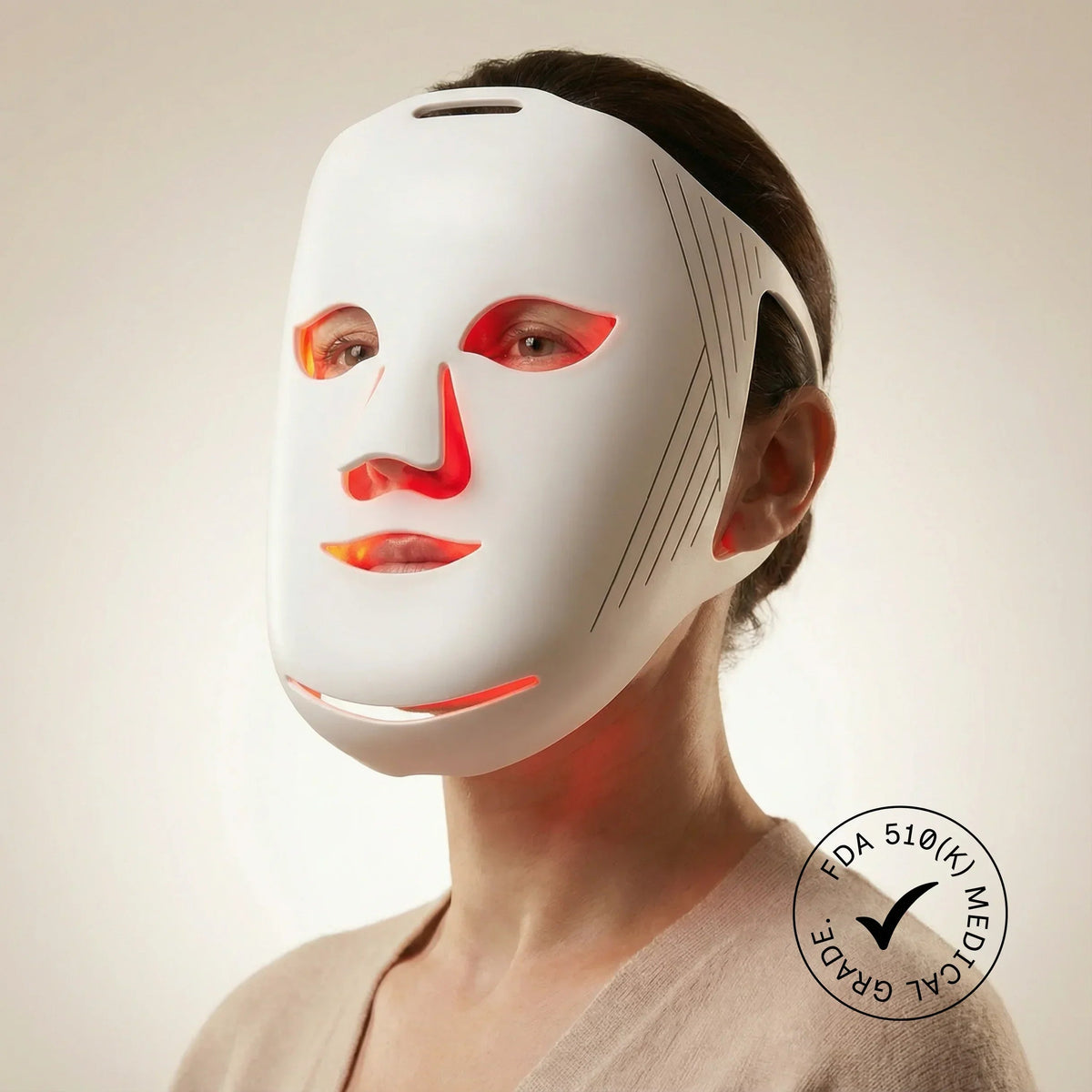
Nicebeam LED Face Mask
$319
Wearable · Blue, red, NIR, and laser emitters
A flexible hands free mask with two wavelength programs, three brightness levels, a rechargeable controller, and a preset ten minute session. This hybrid device contains both LED and laser emitters.

Protocol⁴ P1
$8,900
Broad area mobile panel · Six wavelengths
A wheeled panel that moves between vertical and horizontal positions. Its blue, green, red, and near infrared wavelengths operate together across a broad area.
Buyer checklist
Check the details that shape every session
- Intended use and treatment area
- Exact wavelength in each mode
- LED, laser, or hybrid delivery
- Irradiance with measurement distance
- Fluence or enough data to understand the stated session
- Coverage at the working distance
- Independent or combined wavelength controls
- Timer, brightness, cable, battery, stand, and positioning
- Eye protection instructions and included accessories
- Cleaning, storage, warranty, parts, and returns
- Exact FDA status and intended use when claimed
- Product documentation and access to support
Before the first session
Follow the exact model instructions for distance, time, frequency, skin preparation, and eye protection. Review medication and topical product warnings. Ask a qualified clinician before use if you have a light sensitive condition, take photosensitizing medication, are pregnant, receive cancer care, or have a skin or eye concern that may react to light. Stop if you develop persistent redness, pain, blistering, pigment changes, or unusual visual symptoms.[9]
This guide is for general educational purposes and is not medical advice.
Frequently asked questions
LED light therapy buying FAQs
Is LED light therapy the same as red light therapy?
Red light therapy is one part of the broader LED light therapy category. LED devices can emit red, blue, green, amber, near infrared, or combinations. Some red light products also use lasers, so check the delivery technology as well as the color.
What do the different LED light therapy colors mean?
The color identifies a wavelength range and helps define the routine. Blue is commonly chosen for mild to moderate acne. Green is used in routines focused on uneven looking pigmentation. Yellow or amber is used for visible redness and skin tone. Red and near infrared have been studied for visible signs of skin aging.[1]–[6]
Are more LED colors better?
More colors add options. Each useful mode still needs an identified wavelength, a clear purpose, and instructions that fit the device. Seven color names do not establish seven proven benefits.
What is the difference between an LED mask, lamp, panel, and capsule?
A mask stays close to the face. A lamp or arch treats an area from a defined position without being worn. A larger panel expands coverage from a stated distance. A capsule surrounds the body and needs a dedicated space and installation.
What do wavelength, irradiance, and fluence mean?
Wavelength identifies the light. Irradiance is the power reaching a unit of area at a stated distance. Fluence is the energy accumulated over the session. Read all three with distance, time, coverage, and intended use.
Is near infrared light a visible LED color?
No. Near infrared sits beyond visible red. NIR emitters can look dim or unlit while operating, so appearance is not a reliable operating check.
Are LED devices for home use the same as professional treatments?
They can differ in output, coverage, configuration, intended use, and protocol. A result from one professional system cannot be assigned automatically to a home device.
Is LED therapy the same as UV phototherapy or tanning light?
No. LED light therapy devices in this guide do not use ultraviolet light. Medical UV phototherapy and tanning equipment use different wavelengths and serve different purposes.
What is the difference between FDA registered and FDA cleared?
Registration or listing does not mean the FDA reviewed a device. A 510(k) clearance applies to one device and intended use and is based on substantial equivalence. Clearance is not the same as approval.[7], [8]
What should I check before using an LED device at home?
Follow the instructions for distance, time, frequency, skin preparation, and eye protection. Review medication and topical product warnings. Bring photosensitivity, pregnancy, active cancer care, or a light sensitive skin or eye concern to a qualified clinician before use.
Read the label carefully
FDA registered, cleared, and approved mean different things
FDA registration or listing is an administrative requirement. It does not mean the FDA reviewed a product for safety or effectiveness.
A 510(k) clearance applies to a specific device and intended use after the FDA determines that it is substantially equivalent to a legally marketed device. It is not FDA approval and does not validate every claim made for the brand.[7], [8]

About the founder
Nacho González
I’m Nacho González. I built Kinaura Life as the store I wanted to find myself: every product with a reason to exist, service that matters as much as what we sell, and one goal, supporting better living, for longer. Behind it, a passion for digital marketing that has spanned my entire professional life, the last 10 years of it in health.
If you need help choosing, call (302) 208-4650 or email hello@kinauralife.com.
Sources
Sources and methodology
Reviewed September 7, 2026. Product details and prices reflect the live Kinaura catalog on that date. Clinical statements are limited to the populations, devices, wavelengths, and protocols described in the cited sources.
- Ershadi S, Barbieri JS. At-home LED devices for the treatment of acne vulgaris: a systematic review and meta-analysis. JAMA Dermatol. 2025;161(5):552-555. doi:10.1001/jamadermatol.2025.0019.
- American Academy of Dermatology Association. Lasers and lights: How well do they treat acne? Schaumburg (IL): American Academy of Dermatology Association; cited 2026 Sep 7. Available online.
- Lee SY, Park KH, Choi JW, Kwon JK, Lee DR, Shin MS, et al. A prospective, randomized, placebo-controlled, double-blinded, and split-face clinical study on LED phototherapy for skin rejuvenation. J Photochem Photobiol B. 2007;88(1):51-67. doi:10.1016/j.jphotobiol.2007.04.008.
- Wunsch A, Matuschka K. A controlled trial to determine the efficacy of red and near-infrared light treatment in patient satisfaction, reduction of fine lines, wrinkles, skin roughness, and intradermal collagen density increase. Photomed Laser Surg. 2014;32(2):93-100. doi:10.1089/pho.2013.3616.
- Russell BA, Kellett N, Reilly LR. A study to determine the efficacy of combination LED light therapy in facial skin rejuvenation. J Cosmet Laser Ther. 2005;7(3-4):196-200. doi:10.1080/14764170500370059.
- Zein R, Selting W, Hamblin MR. Review of light parameters and photobiomodulation efficacy: dive into complexity. J Biomed Opt. 2018;23(12):1-17. doi:10.1117/1.JBO.23.12.120901.
- US Food and Drug Administration. Are there “FDA registered” or “FDA certified” medical devices? How do I know what is FDA approved? Silver Spring (MD): FDA; 2021. FDA consumer guidance.
- US Food and Drug Administration. The 510(k) program: transcript. Silver Spring (MD): FDA; cited 2026 Sep 7. FDA 510(k) program.
- Jagdeo J, Nguyen JK, Ho D, Wang EB, Austin E, Mamalis A, et al. Safety of light emitting diode-red light on human skin: two randomized controlled trials. J Biophotonics. 2020;13(3):e201960014. doi:10.1002/jbio.201960014.